For more than a decade, the solar mounting industry was largely built around one familiar question: how can more PV capacity be installed on available land at a lower cost? That question still matters, but land competition, grid constraints, climate risks, and the changing needs of project owners are creating a new market. Solar mounting systems are increasingly expected to do more than hold modules in place. They must work with crops, livestock, reservoirs, water infrastructure, and long-term environmental requirements.
This is why Agri-PV and floating PV are becoming two of the most watched directions in solar mounting.
According to REN21’s Renewables 2025 Global Status Report, agrivoltaics is moving from the pilot stage toward a productive economic activity. The report estimates that the global agrivoltaics market was worth approximately USD 4.59 billion in 2024. In January 2026, IEA PVPS also published an updated fact sheet on floating photovoltaic power plants, highlighting the technology’s potential to address land-use constraints while drawing attention to reliability, environmental conditions, and maintenance.
For mounting manufacturers and engineering companies, these developments point to a clear shift: future growth will depend less on standardization alone and more on application-specific engineering.
1. Agri-PV: Mounting systems must serve two users
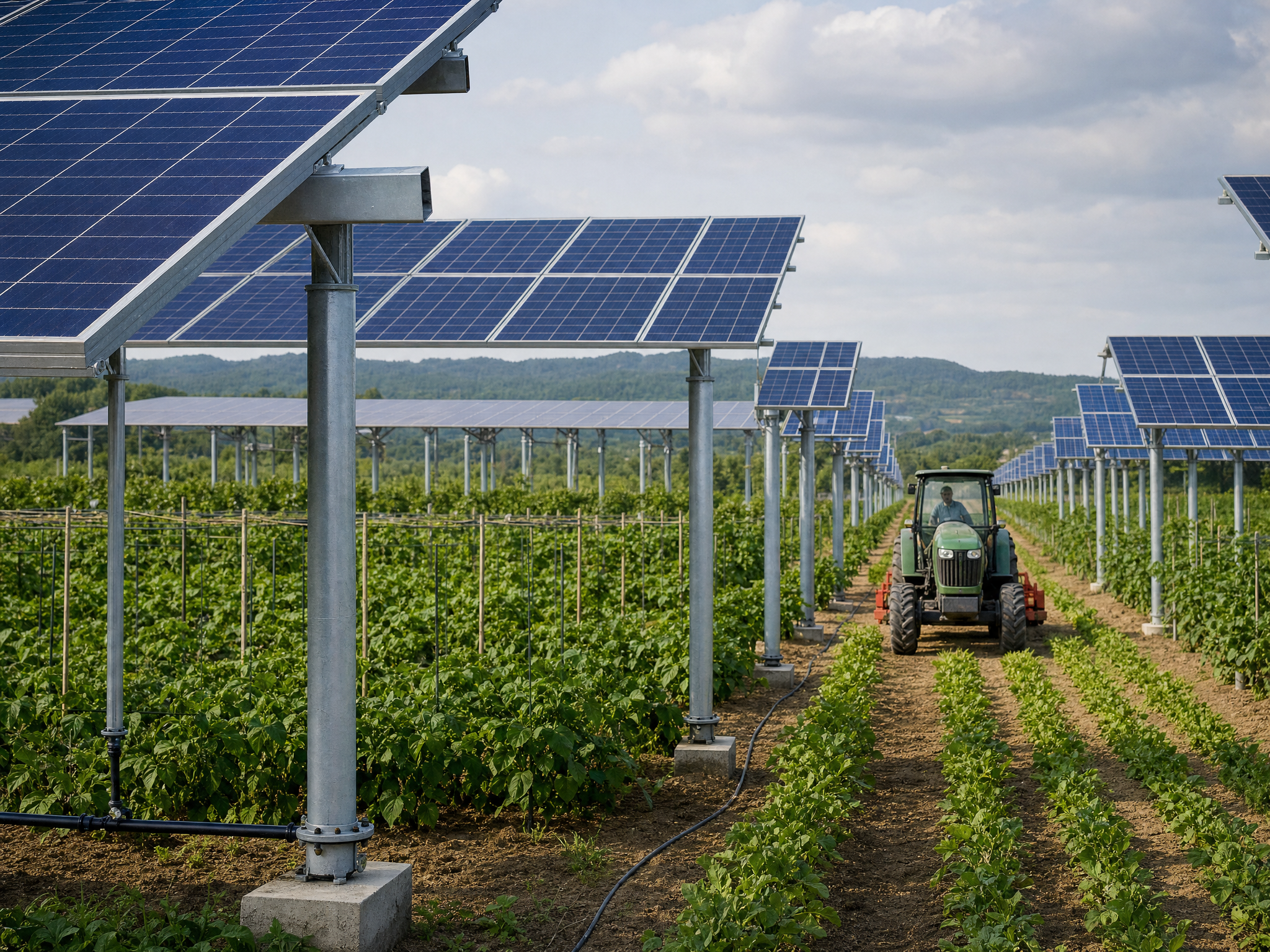
gri-PV combines solar electricity generation with agricultural activity on the same site. Depending on the project, the land below and between the modules may be used for crop production, grazing, greenhouses, or farm operations.
The mounting structure therefore has to satisfy two users at once: the PV asset owner and the farmer. A structure that produces energy efficiently but blocks machinery, damages crops, or makes cultivation impractical will not deliver a bankable project.
This creates several important design requirements:
These requirements make Agri-PV fundamentally different from a conventional ground-mounted solar farm. The cheapest steel tonnage is not necessarily the lowest-cost solution. Project developers must also consider agricultural yield, equipment access, construction time, maintenance routes, and the cost of modifying the site later.
For mounting suppliers, this opens opportunities in elevated fixed-tilt systems, adjustable structures, greenhouse-integrated PV, and application-specific foundations. It also increases the value of early cooperation with agricultural consultants, EPC contractors, and landowners.
2. Floating PV: Water changes the engineering problem
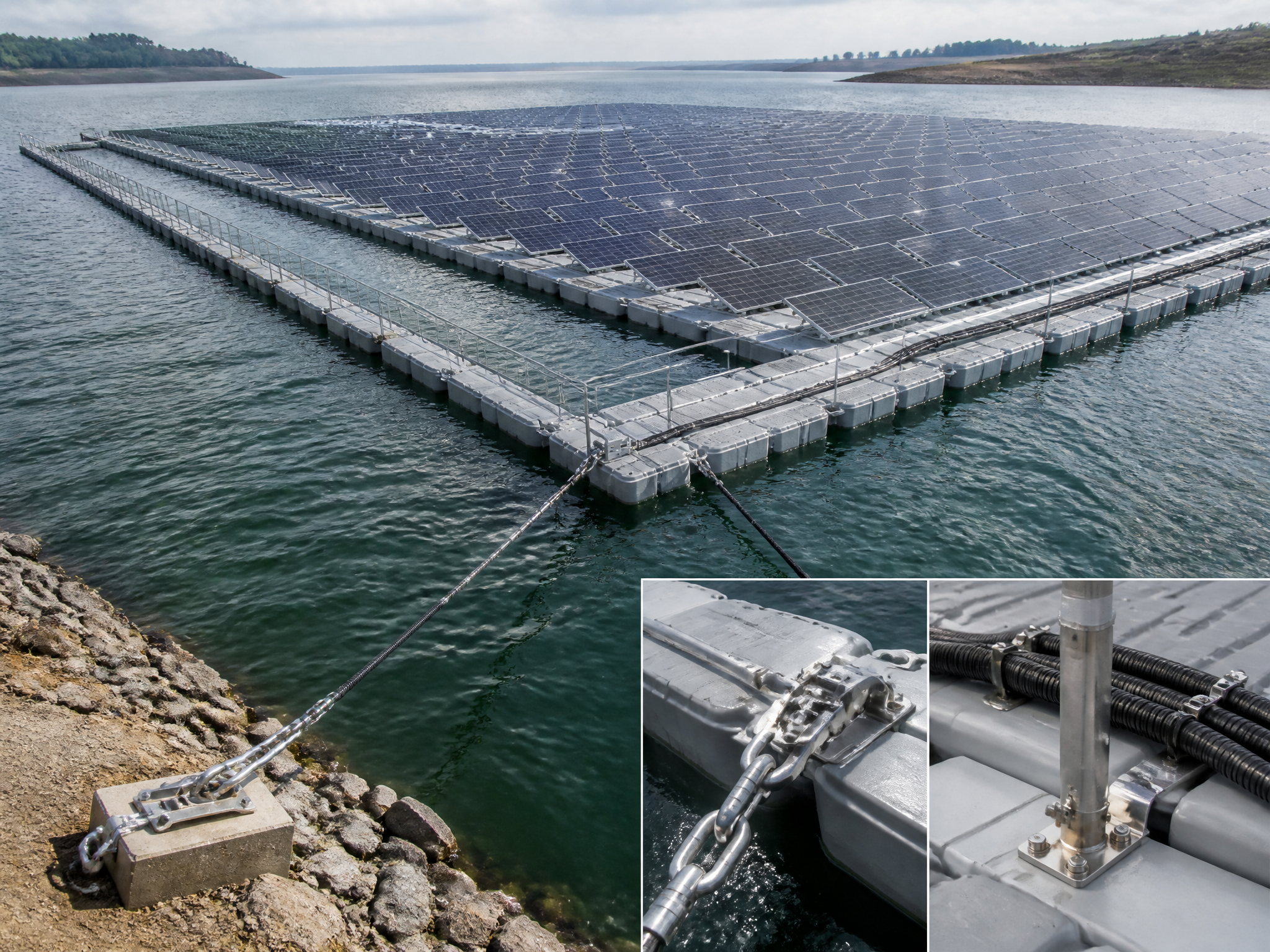
Floating PV places solar modules on buoyant platforms installed on reservoirs, quarry lakes, irrigation ponds, and other suitable water bodies. Its main attraction is efficient land use. In regions where land is expensive, densely populated, or needed for food production, water surfaces can provide an additional location for solar generation.
However, floating solar is not simply ground-mounted PV with floats added underneath. The mounting system must respond to a moving and corrosive environment.
Key engineering issues include:
IEA PVPS notes that floating PV performance cannot be generalized across all installations. Thermal behavior, soiling, wave-induced losses, degradation, and reliability depend heavily on system design and site conditions. That is an important message for the mounting industry: a product proven on a calm inland reservoir may not be suitable for a large wind-exposed lake.
The next generation of floating PV mounting systems will likely be judged on lifecycle performance rather than initial purchase price alone. Suppliers that can provide site-specific load calculations, mooring studies, corrosion strategies, inspection plans, and replacement procedures will have an advantage over companies offering only standard float assemblies.
3. What both markets mean for solar mounting manufacturers
Agri-PV and floating PV share one commercial lesson: the mounting system is becoming part of the project solution, not just a component in the bill of materials.
First, engineering capability will matter more. Customers will expect structural calculations, wind and snow-load analysis, foundation recommendations, material specifications, and installation guidance. In floating projects, hydrodynamic and mooring analysis may be equally important.
Second, materials and corrosion protection will receive greater attention. Hot-dip galvanized steel, aluminum alloys, stainless steel fasteners, protective coatings, and compatible connection details must be selected according to the actual environment. Mixing materials without considering galvanic corrosion can create failures that are difficult to detect after installation.
Third, modularity will become a competitive advantage. Projects differ by crop, water body, climate, module size, row layout, and construction equipment. A modular system that supports multiple elevations, spans, angles, and connection configurations can reduce engineering time while retaining project flexibility.
Finally, operation and maintenance will influence purchasing decisions. Owners increasingly want inspection access, replaceable parts, clear documentation, and predictable service life. A mounting supplier that helps reduce maintenance uncertainty can contribute to project bankability, even if its initial product price is not the lowest.
Agri-PV and floating PV are not short-term design trends. They reflect a broader change in how solar projects are developed. PV systems must now share space with agriculture, water resources, local communities, and existing infrastructure.
For the solar mounting industry, this creates a more demanding market but also a larger one. The companies most likely to benefit will be those that combine structural reliability with site-specific design, corrosion knowledge, construction practicality, and long-term service support.
The next hot direction in solar mounting will not be defined by a single bracket or profile. It will be defined by the ability to make solar work in places where conventional ground-mounted systems are no longer enough.